
Cookware packaging · Delhi NCR
Retail-ready cartons for cookware and stainless steel utensils.
Cookware packaging from Packsmith India: Printed boxes for kadai, frypans, pressure cookers, casseroles, dinner sets and stainless steel utensils. Scratch-safe construction with the print quality that sells on a retail shelf — supplied in bulk to cookware brands across Delhi NCR, Wazirpur and Nangloi.
Specifications
What goes into a cookware carton
Why Packsmith
Why cookware brands print with Packsmith
Cookware is sold on how it looks on the shelf and how it arrives at the customer’s door. We handle both — premium print and protective structure — under one roof.
Who it’s for
Products we pack every month
Pressure cookers · Kadai and woks · Frypans and tawas · Casseroles · Dinner sets · Stainless steel storage and serveware · Tri-ply and ceramic cookware for brands, OEMs and exporters in Delhi NCR and beyond.
FAQ
Common questions
Cookware packaging: how to brief a carton that sells on the shelf and survives the truck
Cookware packaging is the first thing a shopper touches before the pan itself. A pressure cooker, kadhai or tri-ply set is heavy, has sharp handles and is usually sold in a crowded aisle next to ten competitors, so the carton has to be strong, printed to retail standard and sized tightly to keep freight down. Below is the brief we use with cookware brands at Packsmith — follow it and your first run will come out right.
1. Choose cookware packaging board by weight and display
Single pieces up to about 2.5 kg (fry pans, tawas, 2–3 litre cookers) work in 3-ply E-flute with a 250–300 GSM printed top sheet. Cookers from 5 litres, kadhai with lids and casserole sets should move to 5-ply B-flute. Multi-piece gift sets of 3–7 pieces packed with inserts belong in 5-ply BC. If the cookware packaging will be stacked five-high in a modern-trade back room, add 2–4 kg/cm² to the bursting strength you would otherwise choose.
| Cookware | Packed weight | Board | Finish we recommend |
|---|---|---|---|
| Fry pan, tawa, sauce pan | 0.6–2.5 kg | 3-ply E-flute | Offset + gloss lamination |
| Pressure cooker 2–5 L | 1.5–3 kg | 3-ply E / 5-ply B | Metallised UV print |
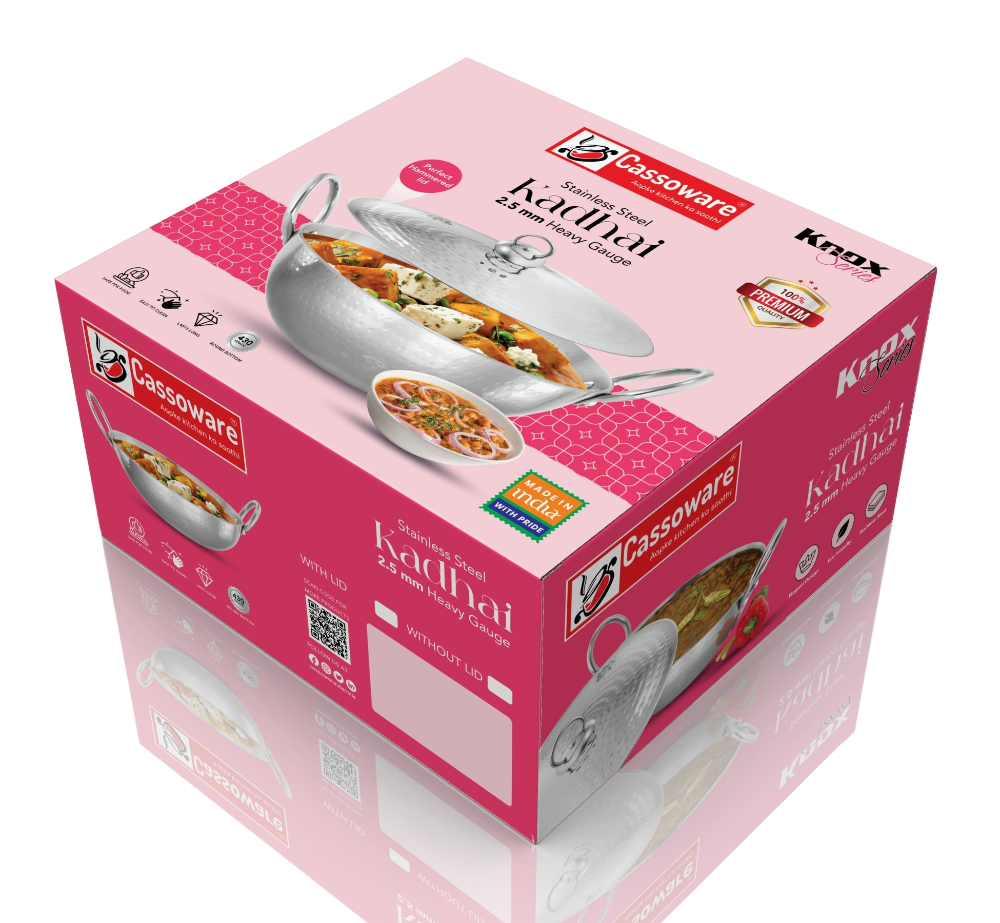
| Kadhai / casserole with lid | 2–4 kg | 5-ply B-flute | Offset + matte or gloss |
| 3–7 piece cookware set | 4–9 kg | 5-ply BC-flute + insert | Metallised UV, spot UV logo |
2. Metallised UV print: why cookware brands ask for it
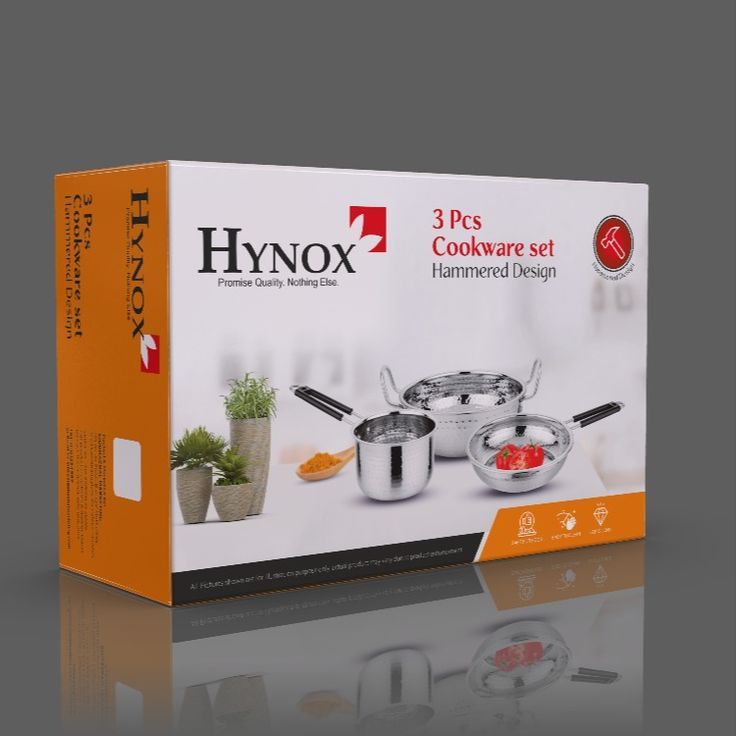
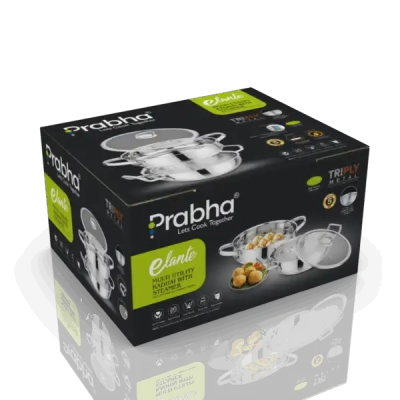
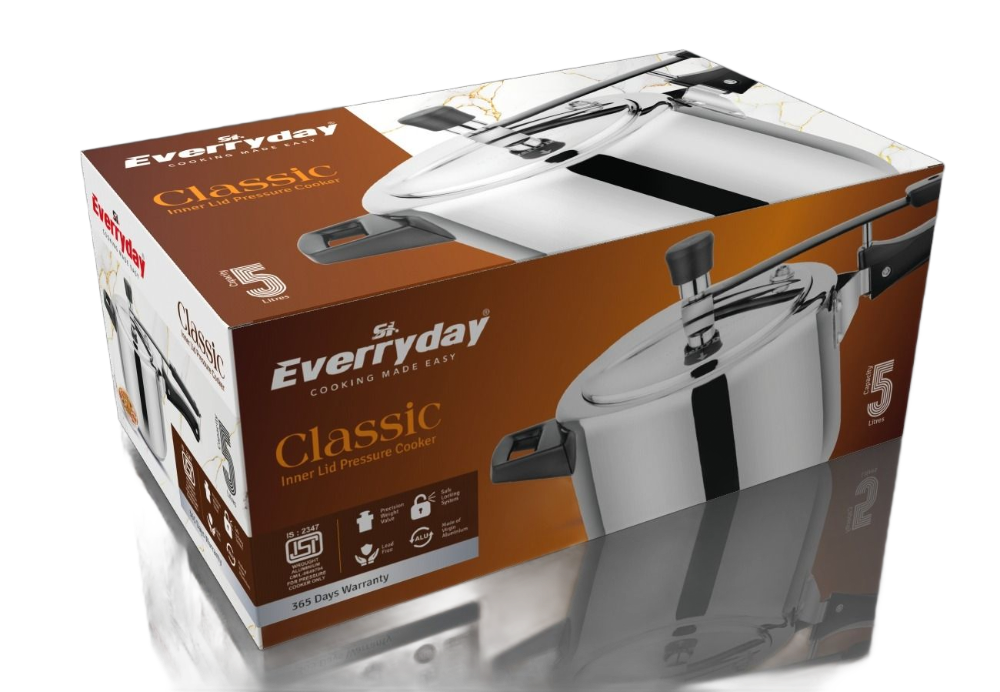
For cookware packaging, stainless steel and hard-anodised products photograph with a lot of reflection. On plain white board that reflection goes flat; on a metallised (met-pet) film laminated sheet with UV-cured inks, the silver base shows through and the product looks like it does under store lights. It is the single most requested finish in cookware packaging and it is what we built our UV line around. Spot UV on the logo and a matte varnish on the background complete the premium look.
3. Handles, lids and inserts in cookware packaging
Most cookware packaging damage happens inside the box, not outside: a handle punches through a panel, a glass lid cracks against the pot. Our inserts for cookware packaging are corrugated partitions or die-cut pads that hold the lid upside-down on the pot with a buffer, plus a corner block on the handle side. For gift sets we design nested cradles so each piece sits in its own cavity. Inserts also square the box, which is what makes a stack stable.
4. Sizing to the product, not to the nearest standard box
Every 10 mm you add to cookware packaging adds board cost and, more importantly, volumetric freight. We measure the packed product (with insert) and build the dieline to it, then check that the size nests efficiently on our 28×40 in sheet. A tight dieline often saves more than the print finish costs. Use the box size calculator to get a quick outer dimension and estimate.
5. Retail compliance panel on cookware packaging
Cookware packaging in India needs the Legal Metrology declarations (MRP, net quantity or size, manufacturer/packer name and address, customer care contact, month and year of packing) on the principal display panel or an adjacent panel. Induction-compatible claims, non-stick coating claims and BIS marks where applicable should sit in the same block. The Legal Metrology division publishes the rules; we keep the panel space and font size compliant in the dieline so your team only has to drop in the text.
6. Quantities, lead time and delivery
Our MOQ for printed cookware packaging is 1,000 pieces per design. Sampling takes 3–5 working days, bulk 7–10 working days after artwork approval. Delivery is on our own vehicles across Delhi NCR — Bawana, Wazirpur, Kundli, Noida — and by transport to the rest of North India. Repeat runs reuse your stored dies and plates.
Checklist to send us
- Product name, capacity/size and packed weight
- Pieces per box (single or set) and whether a lid is included
- Where it sells: modern trade, general trade, online, export
- Print finish preference: metallised UV, gloss, matte, spot UV
- Artwork PDF or a product photo for our designers
- Quantity and required delivery date
Still unsure which cookware packaging format fits? Send a photo of the product and the shelf it sells on; our designers will recommend a box, sleeve or window pack and send a dieline the same day, free of charge for confirmed orders.
One last practical tip: ask your retailer which shelf the product will sit on before you finalise the artwork. Eye-level shelves reward big product photography; bottom shelves reward a bold brand colour and a large capacity mark that can be read from standing height. The same cookware packaging dieline can carry either layout, so the decision costs nothing but changes sell-through.
WhatsApp these to 98107 42123 and you will have a dieline, sample plan and price for your cookware packaging within 24 hours.
Complete cookware packaging guide (expand any section)
Detailed notes from the jobs we run every week for cookware brands — open the sections you need.
Cookware packaging by product: cookers, kadhai, tawa, tri-ply and gift sets
Pressure cookers. The most-printed box in Indian cookware packaging. Inner-lid cookers need a flat die-cut pad to hold the lid and gasket; outer-lid cookers pack lid-on with a top pad. 2–3 litre units go in 3-ply E-flute, 5 litre and above in 5-ply B-flute. Print the capacity large on two faces because retailers stack cookers by litre.
Kadhai and wok. Wide and shallow with two handles. The carton is wide but short, so it is prone to bowing; a 5-ply board with a centre partition fixes it. If a glass lid is included, pack it inverted inside the kadhai with a corrugated ring.
Tawa and fry pans. Flat boxes with a long handle sleeve. Many brands use a sleeve or hang-tab pack instead of a full box for budget lines; for premium non-stick lines a full printed box with a window patch sells better. Both are cookware packaging formats we produce.
Tri-ply and stainless sets. Heavy and expensive. 5-ply BC carton, nested cradle insert, metallised UV print and often a carry handle die-cut in the top. These sets are gifted during the festive season, so a reinforced box that looks premium matters more than a few rupees of board.
Hard-anodised and ceramic-coated ranges. Coatings scratch, so the insert must keep pieces from touching each other. Tissue or foam sheets between pieces plus a snug cradle is the norm.
Artwork and finishing checklist for cookware packaging
Supply print-ready PDFs in CMYK at 300 dpi with 3 mm bleed; keep text 5 mm inside creases. Product photos should be shot on a neutral background with the reflection you want to see on the shelf — the metallised base will amplify it.
Choose the finish for your cookware packaging by where the box lives: gloss lamination for general trade (easy to wipe, bright), matte lamination with spot UV for premium ranges, metallised UV for anything stainless or copper.
Include the barcode, MRP block and the brand’s customer-care number on the same panel. Before bulk, approve a physical sample under daylight and check that the auto-lock base clicks shut without tape; we store the approved sample as the colour standard for every repeat order of your cookware packaging.
Export cartons and master packing for cookware
For GCC, Africa and South Asian buyers, cookware packaging ships as printed retail boxes inside a 5- or 7-ply kraft master carton holding 4–12 units. We print shipping marks (consignee, carton number, gross and net weight, dimensions, country of origin, handling symbols) on two adjacent faces and can add buyer-specific SKU labels.
Sea freight humidity is the main risk for cookware packaging, so we use virgin kraft liners and moisture-resistant adhesive, and recommend a poly bag inside each retail box. Pallet patterns are designed so that the master carton size divides a standard 1,200 × 1,000 mm pallet without overhang. Full details in our export carton checklist.
Frequently asked questions about cookware packaging
Can the same box carry two capacities? Yes, with a universal insert and a variable panel for the litre mark — common for 3 L and 5 L cookers.
Is metallised print much more expensive? Typically 15–25% over plain offset with lamination; most brands recover it in shelf conversion.
What is the MOQ? 1,000 pieces per design for printed cookware packaging; master cartons lower.
How long for repeat orders? 5–7 working days, since dies and plates are stored.
Do you make hang-tab sleeves and window boxes? Yes — sleeves, window-patch boxes and full cartons are all in-house.
Do you deliver to Bawana / Wazirpur / Kundli? Daily, on our own vehicles.
What drives the price of cookware packaging, and how to bring it down
Five things set the price of cookware packaging: board grade and GSM, the outer size (it decides how many boxes come out of one 28×40 in sheet), print colours and finish, the insert, and the run length. Of these, size and run length are the two most buyers can influence. A dieline trimmed by 10 mm on each side can move a job from 2-up to 3-up on the sheet and cut board cost by a quarter; a 3,000-piece run spreads plate, die and set-up over three times as many boxes as a 1,000-piece run.
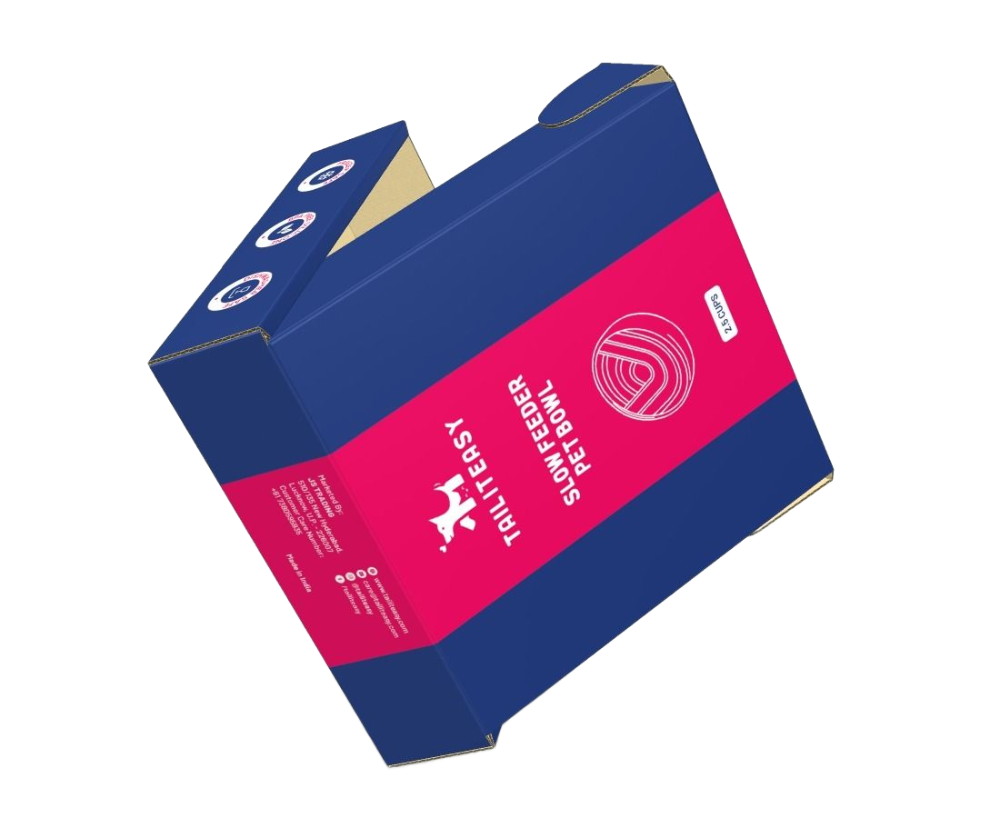
Finish choices are the next lever. Metallised UV is the premium option; plain offset with gloss lamination is around 15–25% cheaper and still retail-ready. Spot UV costs little if the plate is already being made. Kraft board with one or two colours is the budget end and works well for D2C and e-commerce brands whose box is seen only after purchase.
Finally, plan repeat orders. Once your cookware packaging dies and plates are stored with us, each repeat run skips pre-press, so the per-box price and the lead time both drop. Brands that forecast a quarter ahead and order in two or three larger lots typically pay 10–15% less per box than those ordering monthly in small quantities.
Get a quote
Send us your product details — we quote within 24 hours.
Share product, quantity and sizes. Our team recommends board grade and print finish, then shares pricing and a sample timeline.
Call: +91 98107 42123 · +91 98912 01234
Email: hello@packsmithindia.com